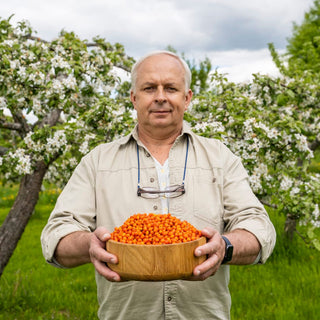
There are two types of sea buckthorn oil: pulp oil and seed oil. Both are excellent sources of vitamins E and K. They’re also rich in carotenoids, which give them their orange colour. That’s why orange carrots are just as beneficial for our eyesight as sea buckthorn berries.
Carotenoids are precursors of vitamin A, and vitamin A in turn plays a key role in how our eyes function. A deficiency in vitamin A can show up as vision problems or as dry skin and eyes. Sea buckthorn is therefore a very useful snack for anyone who spends a lot of time in front of a screen. Compared with the berries themselves, sea buckthorn oil contains carotenoids in several times higher concentration.
Pulp oil and seed oil have very different fatty‑acid profiles. Pulp oil contains more saturated fats, whereas seed oil is rich in healthy unsaturated fats. Sea buckthorn seed oil is the only oil where omega‑3 and omega‑6 occur naturally in a 1:1 ratio.
Both of these omega fatty acids are essential for humans, but in today’s diet omega‑6 is heavily over‑represented – it’s found in fish, pork and poultry, and in many seed oils. Omega‑6 promotes inflammatory reactions as part of the body’s defence system; omega‑3, on the other hand, helps to reduce inflammation once it has arisen. Ideally, their ratio should be 1:1, as it was for our ancestors, or even 2:1 in favour of omega‑3.
Sea buckthorn seed oil is most often taken as a dietary supplement and is recommended in the morning before food. Taken this way, it can help treat gastritis and ulcers, relieve pain and discomfort, and support the healing and renewal of the stomach lining.
Sea buckthorn oil also contains the rare omega‑7 fatty acid, which is found in the lipids of our skin and stimulates cell renewal.
Oil pressed from the pulp is particularly beneficial for the skin, which is why it is widely used in pharmaceutical and cosmetic products. Oil from dried pulp is rich in omega‑7, an important component of skin lipids that stimulates skin renewal and wound healing. Thanks to this, topical use of sea buckthorn oil can help scars fade and soothe and reduce skin inflammation, for example after sunburn or other irritation. Sea buckthorn oil also absorbs UVB radiation, making it suitable as a component of natural sunscreens.
Because of its antioxidant properties, sea buckthorn oil is often included in anti‑ageing and anti‑wrinkle products for mature skin. It firms and tones sagging skin, smooths wrinkles and is suitable for caring for dry, irritated, rough and itchy skin. For centuries, sea buckthorn oil has been used to treat skin damage caused by both cold and heat.
In hair care, sea buckthorn oil is a frequent ingredient in shampoos and conditioners. It is also an excellent addition to hair treatments used after colouring or perming, helping to restore damaged hair, its elasticity and shine.
Because the berries are so impressive, the leaves and their health‑giving properties are often overlooked. Sea buckthorn leaves are rich in flavonoids, carotenoids and sterols, and in terms of antioxidant content they rival the fruit.
Since antioxidants help strengthen the immune system and reduce fever and inflammation, tea made from sea buckthorn leaves is very useful for relieving respiratory complaints and for boosting the body’s overall resistance. It also supports stronger hair growth and helps reduce hair loss. So when autumn comes, don’t forget to harvest some leaves from the shrub as well!